A Gathering of Many Nations at St Peter and St Mark, Levenshulme
Revd George Reeves has been at St Peter and St Mark, Levenshulme, for eight years now. Halfway between the city centre and Stockport, Levenshulme has long been a richly multicultural area.
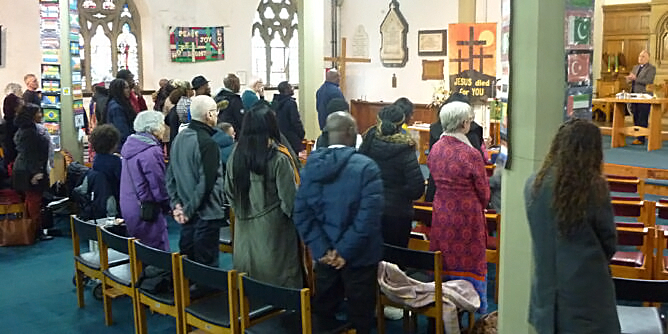
Revd George Reeves has been at St Peter and St Mark, Levenshulme, for eight years now. Halfway between the city centre and Stockport, Levenshulme has long been a richly multicultural area. 60% of the local community is of Pakistani heritage, and there are many people from Roma and various African heritages alongside a large Irish Catholic community.
“It is a very accepting and inclusive community, with a whole mixture of subcultures”, explains George. “We are a gathering of nations in this community, and it’s an incredible place to minister.” He sees this multiculturality reflected in his churches, and an important part of George’s ministry is encouraging respect and inclusion for every person, especially through working with local schools. “We focus on respect over ‘tolerance’, because that can seem negative or passive. We want to raise awareness while reducing fear and mistrust. When I look around church on a Sunday morning, I see Ghanaian, Malawian, Nigerian, Indian, Pakistani, Bangladeshi, Montserratian and Jamaican worshippers all praying together. It’s always been this way, very multicultural!”
The warm welcome offered by the congregations, together with the style of worship, has made St Peter’s and St Mark’s places where all people feel at home – something that has been strengthened over many years. For George, this has been a journey of listening and learning about different styles of intercultural worship, which has resulted in dynamic and lively services. “Sometimes during worship, it feels as though the whole church starts to move. We don’t always get it right, but when we do the place feels like it’s alive with worship. Intercultural is just who we are.”
A moment which perfectly captures the joy of this worship happened recently during open prayer, when many people of all ages were contributing so enthusiastically that the associate minister had to kindly interrupt and move the service along. “Many cultures find it more natural to spontaneously pray out loud, and it is a joy to embrace moments like this”, says George.
Participation is encouraged when the congregation sees leaders at the front who reflect their own backgrounds and experiences. “We have people reading the Bible at the front representing our range of cultural heritages and a whole spectrum of ages,” George explains. “Seeing people like yourself makes you feel welcome and included, although we do still have challenges as to how we can develop this further in leadership opportunities.”
This growing community is supported by congregation members who are especially gifted in welcome and hospitality, approaching newcomers and helping them feel at home. Hospitality is hugely important, and occasions such as bring-and-share meals provide an opportunity to celebrate, get to know each other, and enjoy lots of incredible food.
For other churches looking to improve their intercultural ministry, George would encourage them first and foremost to get alongside people and not be afraid to ask questions. “Try to understand people, and don’t try to change them. Ask what brings them to your church, what their faith looks like, and what their worship is like. That doesn’t mean you have to change everything you’re already doing, but get to know people and embrace these different cultures.”
Looking to the future, George wants to build on the diversity of leadership at St Peter’s and St Mark’s. He plans to invite people to come and preach, in the hope of encouraging vocations and opportunities amongst the breadth of his congregations. There are also plans to update the welcome area in each church to include different languages, so everyone feels instantly at home as they arrive in the buildings.
For George, these steps aren’t just ideas: they reflect the heart of the church community. “Nobody is discriminated against here based on their heritage or nationality”, he explains. “The nations have come to us. Matthew 28 encourages us to make disciples of all nations, and that is what we are trying to do. This is who we are!”