Racial Justice Sunday Reflections
In the weeks leading up to Racial Justice Sunday, we are sharing reflections from voices across our diocese, which highlight why this day matters.
As we look ahead to Racial Justice Sunday on 8th February, we pause to focus on the important role racial justice plays in shaping our churches and communities. In the weeks leading up to this important day, we are sharing reflections from voices across our diocese, which highlight the positive impact of racial justice and the difference it makes.
Diane Gray-Stephenson – Racial Justice Programme Lead

What Racial Justice Sunday Means to Me
As the Racial Justice Programme Lead, people often assume that Racial Justice Sunday is “my big day” – a moment in the year when all eyes turn to the work I care so deeply about. And in many ways, it is special. It’s a day set aside for prayer, reflection, truth-telling, and courageous hope. But when I think about what Racial Justice Sunday really means to me, it is something far deeper and far more personal than a date on the calendar.
Racial Justice Sunday reminds me of our shared calling as followers of Christ: to love our neighbour, to seek justice, to walk humbly, and to stand alongside those who are hurting or unheard.
It is a call not just to feel compassion, but to act; not just to acknowledge inequality, but to challenge it; not just to name injustice, but to dismantle the systems that allow it to persist.
But here’s the truth I hold most strongly: although it is marked on one day, racial justice cannot be confined to a single Sunday.
It is not an event.
It is not a theme.
It is not a tick-box exercise.
It is a way of being Christian.
Racial Justice Sunday is a reminder. It is a prompt that invites us to look again at our communities, our churches, our assumptions, and our lives. It calls us back to the heart of the Gospel, where Christ breaks down the dividing walls between us, and where every person is recognised as bearing the image of God.
In my role, I see the impact when this commitment becomes part of our year-round discipleship: the brave conversations; the small, faithful steps; the willingness to listen; the hearts that soften; the cultures that shift; the testimonies of belonging where once there was pain. These are the moments that tell me the Spirit is moving.
So, what does Racial Justice Sunday mean to me?
It is a spark – beautiful and important – but it is not the fire. The fire is what we tend every day, in every parish, in every meeting, in every act of welcome and every challenge to injustice.
My hope is that this year, as we reflect on “Love Your Neighbour”, this day becomes not just a service we attend, but a journey we choose. A journey that lasts far beyond a Sunday.
Because racial justice is not a day in the diary.
It is the daily work of love.
The Revd Daniel Ramble – Area Dean of Oldham and Ashton Deanery

Strangers into Kin: Living Racial Justice in the Church
The late Archbishop Desmond Tutu once said, “Ubuntu… speaks of the very essence of being human… my humanity is caught up and is inextricably bound up in yours.”
Racial Justice Sunday calls the Church to receive that truth of belonging not merely as a sentiment, but as a discipline and rule of life. This year’s theme, Love thy neighbour, asks us to reflect: does our common life make people feel merely tolerated, or truly cherished? Are they included at the edges, or unmistakably at home?
Christian faith is irreducibly relational. We are formed not in isolation, but in encounter: with God, with neighbour, and with our own God-given humanity. Scripture insists that love of God and love of neighbour are inseparable, and Jesus makes clear that both are measured “as yourself.” Self-worth is the greatest antidote to ‘othering’.
The Orthodox and Eastern traditions remind us that the face of the other is integral to worship and that a truthful love of self, rooted not in self-absorption but in God-given dignity, makes such love possible. To diminish another’s worth, by race, culture, accent, food, or history, is a wound to the Body of Christ. To deny one’s own worth is equally to obscure the divine image God has already declared good and beloved.
The Eucharist is the school of this love. We approach the table not as owners or hosts, but as guests. The host is Jesus Christ – bread broken, life poured out, welcome made flesh. Here, “neighbour” is not a safe category of people like us, but whoever God places before us; not a problem to manage, but a mystery to revere.
Racial justice is Gospel work. It is the Church resisting the world’s habit of othering and recognising the abundance of this ‘divine image in each other’ even where political discourse weaponised economic austerity as deficit, and turned migrants and refugees into scapegoats for failures that are social, structural, endemic and shared. This is patient, intergenerational work: building communities where truth may be spoken without fear, repentance offered without humiliation, leadership shared without suspicion, and difference received as a gift rather than a threat.
It is demanding, yet hopeful. The One who gathers us is already making strangers into kin. Our calling is simply to live, here and now, as though that were already true.
Deborah Smith – Diocesan Director of Education

I feel the need to start with a confession. When asked to contribute a few thoughts about Racial Justice Sunday my initial response was ‘I am happy to but if I am being honest it is not something that I have really thought about.’ To clarify, the church I currently attend has not celebrated Racial Justice Sunday as yet and I haven’t thought about this until recently. Maybe this demonstrates how easy it is to overlook issues when they don’t directly affect us.
In my work as Diocesan Director in Manchester Diocese I am involved in promoting and advocating for racial justice, especially its’ link to our faith. I take great delight in celebrating the work of the Shades team and all they are accomplishing in schools and more recently churches across the diocese.
One of my favourite passages is Psalm 139 verses 13-16. In particular where David praises:
‘For you formed my inward parts;
You wove me together in my mother’s womb.
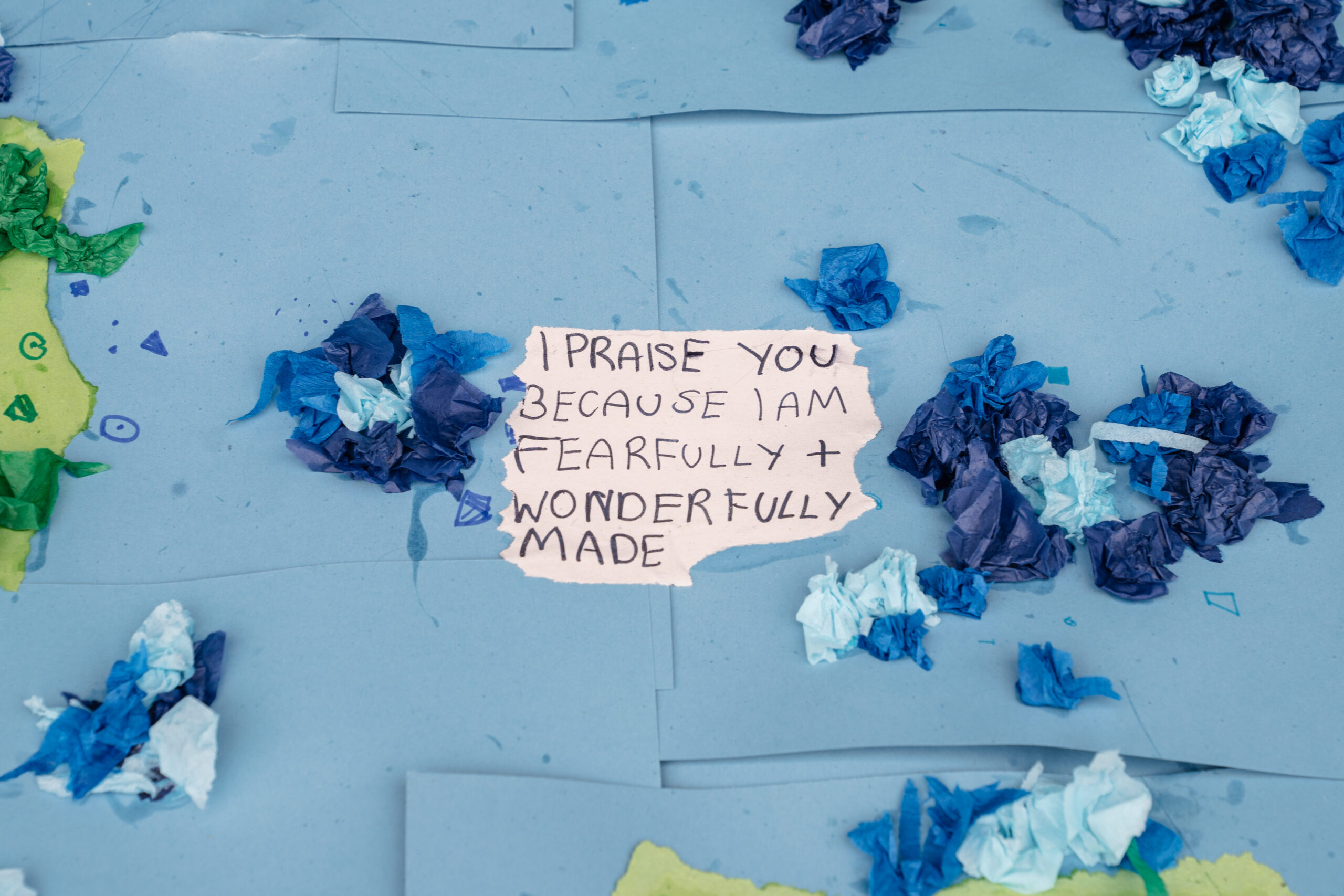
I will give thanks to You, for I am fearfully and wonderfully made.’
The acknowledgement that each of us is created by God, deliberately and intentionally blows my mind. Earlier in Genesis 1 we are also told that we are each created in God’s image. The uniqueness of each of us is something that amazes me. God could have created us all the same, but He didn’t. Although we are all individual, we share our humanity, recognising how we each reflect God’s image. This is not dependent on our race or colour, where we were born, where we live, how clever we are or our family histories. Each of us ‘is fearfully and wonderfully made.’
In response to this I abhor racism. Through connecting with the work of the Shades team and the recently established Racial Justice team in the diocese I am learning how I can do more and go further to not only react to racism but to proactively promote racial justice as a demonstration of my commitment to live as God intended. I’m learning how I can use my white privilege to advocate for racial justice, to speak out and promote a Godly way of living. I believe we are called ‘to act justly and to love mercy and to walk humbly with our God. (Micah 6:8) May we each continue to do this as we bow to the will of our Father who created us all.
Mo Blue – Brunswick Church Community Programme Manager

What Racial Justice Sunday Means to Me
Racial Justice Sunday is personal to me. I am a 61-year-old Black woman, born in England to parents who came here as part of the Windrush generation. My parents arrived with hope, faith, and the belief that their hard work would build a better future for their children. They gave so much to this country, yet they faced racism, exclusion, and injustice that often went unspoken.
Racial Justice Sunday provides an opportunity to acknowledge those painful truths – not to dwell in bitterness, but to speak honestly.
As a mother and a grandmother, I think about the world my children and grandchildren are growing up in. I pray that they will be accepted for who they are and allowed to live without having to prove their worth or right to belong.
For me, Racial Justice Sunday is about remembering, reflecting, and hope. It is a time to listen, to learn, and to act. It reminds me that justice plays a significant role in our faith, which may mean standing against racism in different ways.
It is also a lovely reminder that change is possible, and that by speaking the truth, honouring and remembering the past, and caring and sharing with the next generation, we can all help to take small steps to build a world where everyone is valued equally.
Paul Keeble – Member of Brunswick Church

Racial Justice Sunday. One day down, 364 to go. One day to focus on an issue that cuts through our society and lives every day in so many ways, whether we realise it or not.
For many years I was one of the “or nots”. It’s hard to be aware of or question something that has always been there, especially if you benefit from it. But, thanks to patient non-white friends, my awareness of my privilege as a white, straight, male has been growing. It has a way to go: lifetime attitudes and knee-jerk assumptions take a while to be spotted and erased, and I have many more mistakes yet to make. But I think/hope/pray I’m moving in the right direction.
A key moment for me was when my British Jamaican friend Ray casually mentioned being followed around a DIY store by Security. I thought, hang on, that has never happened to me! But that, or something similar, I’ve since discovered is the common experience of just about every non-white person I’ve told that story to. Then there was the time when my wife and I accidentally set off an alarm at a shop in London. Security walked past us and collared a young black man just behind us. To borrow a phrase another friend uses: his daily indignity; our unearned privilege.
So… Racial Justice Sunday. A day to reflect on the daily experience of non-white brothers and sisters, and for us white folks to listen to their stories, and learn about how this white supremacy myth buried itself in our psyches and society, so it can be brought into the light. And ask for God’s help to take our new and growing awareness into the other 364 days.
Explore a range of resources and practical ideas to help you prepare for Racial Justice Sunday, available now on our website.