Diocesan Synod meets at St John’s House
Members of Diocesan Synod met on Saturday to consider a range of business, including progress towards Net Zero, approval of the MDBF budget, feedback from the recent Deanery Gatherings and the Manchester Diocesan Board of Education's Annual Report.
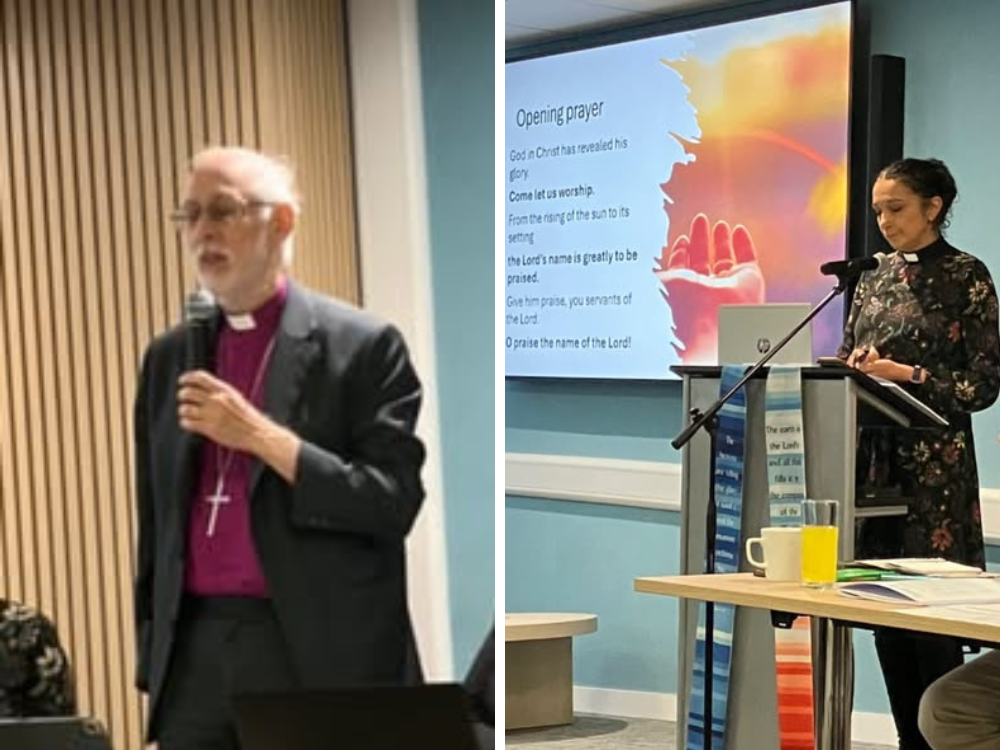
Members of Diocesan Synod met at St John’s House on Saturday to consider a range of business, including progress towards Net Zero Carbon, approval of the Manchester Diocesan Board of Finance budget, feedback from the recent Deanery Gatherings and the Manchester Diocesan Board of Education’s Annual Report. Synod also received an update on the work of General Synod, including the recent elections.
Presidential Address
Following the opening worship led by Canon Grace Thomas, Bishop David delivered his Presidential Address. He reflected on a series of recent engagements, highlighting the importance of chaplaincy, religious education and theological study in helping people engage with faith in today’s world.
Bishop David began by speaking about a conference of airport chaplains that took place last week at Manchester Airport and was attended by chaplains from all around the world. During his speech, he highlighted the vital role they play in supporting people at some of the most difficult moments of their lives.
Airport chaplains minister in a unique environment and may find themselves offering care to those affected by bereavement, supporting distressed travellers, responding to incidents involving modern slavery or accompanying families during repatriations. Reflecting on the conference, Bishop David described chaplaincy as a practical example of people of different faiths working together in service of others. He suggested that effective multi-faith engagement is often demonstrated not only through dialogue, but through a shared commitment to serving the wider community.
Bishop David also spoke about a recent visit to E-ACT Royton and Crompton Academy as part of the House of Lords’ Learn with the Lords programme. During the visit he spent time with pupils taking their questions on a wide range of ethical and religious issues.
The experience reinforced the importance of Religious Education in helping young people explore complex questions and understand the continuing significance of faith in society. He also encouraged clergy to build strong relationships with their local schools, noting that those relationships can be valuable whether or not a school has a Church foundation.
Bishop David went on to reflect on the importance of theological education and research. He referred to a recent conversation at the Lincoln Theological Institute with a doctoral student researching liberation theology and the Church in Nigeria. The discussion prompted reflection on the richness of theological scholarship across the Anglican Communion and the different ways Christians interpret scripture in response to local circumstances and challenges.
He also noted research taking place in areas such as eco-theology, and spoke about the need to encourage young people to engage seriously with religion and theology. Strong Religious Education, he suggested, provides an important foundation for those who may go on to shape the Church’s theological life in the future.
In concluding, Bishop David spoke about his continuing contributions to BBC Radio 4’s Thought for the Day. He described the programme as an opportunity to help listeners see how Christian faith can inform our understanding of the world and the choices people make in everyday life. He also noted the value of the broadcasts in raising the profile of the diocese and bringing Christian perspectives to a national audience.
Across these reflections, Bishop David returned to the importance of maintaining a Christian presence in public life, whether through chaplaincy, education, theological research or the media. Some of the themes he raised would also feature in Synod’s later discussions, including creation care.
Net Zero Update
Synod received the annual report from the Environment Working Group, highlighting progress across the diocese’s Net Zero and creation care work. Members heard about growing participation in the Eco Church programme, support for decarbonisation projects in churches, schools and clergy housing, training and networking opportunities, and successful bids for funding to help reduce carbon emissions.
Synod also celebrated the announcement that St John’s, Pendlebury has become the first church in the diocese to achieve A Rocha UK’s Gold Eco Church Award, recognising its leadership in environmental stewardship and marking a significant milestone in the diocese’s journey towards greater care for creation. The award follows work to decarbonise the church building through measures including electric heating and solar panels, with the parish sharing its learning with others across the diocese.
Budget Update and Governance Review
Synod received a finance update on the proposed 2027-2029 budget. Members heard that the budget remains subject to a successful application for Additional Time Limited Funding (ATLF) from the National Church, with a draft submission having received positive feedback ahead of a final decision expected in early 2027.
Synod approved the budget report and received an update on work to strengthen governance and assurance across the diocese, including the development of a Corporate Risk Register, Board Assurance Framework and updated governance processes designed to support effective stewardship, accountability and safeguarding.
Synod also heard the news that David Weldon, Director of Finance, will be leaving the diocese at the end of January 2027 to take up a new role at Rochdale Town Hall. Announcing the move, Bishop David thanked David for his outstanding contribution to the organisation, praising his ability to manage complex financial issues with professionalism, clarity and good humour, while remaining a generous and supportive colleague.
Feedback from Deanery Gatherings
Members of Diocesan Synod received a report on feedback gathered through this year’s Deanery Gatherings, offering a picture of both encouragement and challenge across the diocese.
The gatherings brought together clergy and lay leaders to reflect on the diocesan vision and priorities. While the feedback highlighted active churches, committed volunteers and signs of growth, it also reflected concerns about volunteer fatigue, stretched clergy resources and long-term sustainability.
Investment in children, young people and families emerged as one of the strongest shared priorities, alongside widespread support for leadership development for both lay and ordained ministers. Respondents also emphasised the importance of local context, arguing that successful mission must grow from local relationships and community needs rather than one-size-fits-all approaches.
Many welcomed the diocesan vision while calling for partnership, consultation and practical support to help churches implement it in ways that reflect local circumstances.
Annual Review for the Manchester Diocesan Board of Education 2025-26
Synod also received the annual report of the Manchester Diocesan Board of Education, reviewing progress against its strategic priorities and highlighting ongoing work to support schools, governors and parishes across the diocese.
General Synod Update
Members then received an update from the Church of England’s General Synod, including recent national business and the results of the latest General Synod elections, which will shape representation for the coming quinquennium.
The next meeting of Diocesan Synod will take place on Saturday, 20th March 2027.